SIGNS OF WAR
Europe and Canada are enacting sweeping changes: conscription revivals, record defense budgets, and mandatory survival kits. These aren't mere precautions, they signal NATO's pivot to seize and escalate Ukraine's war, risking a continental draft and catastrophic losses.
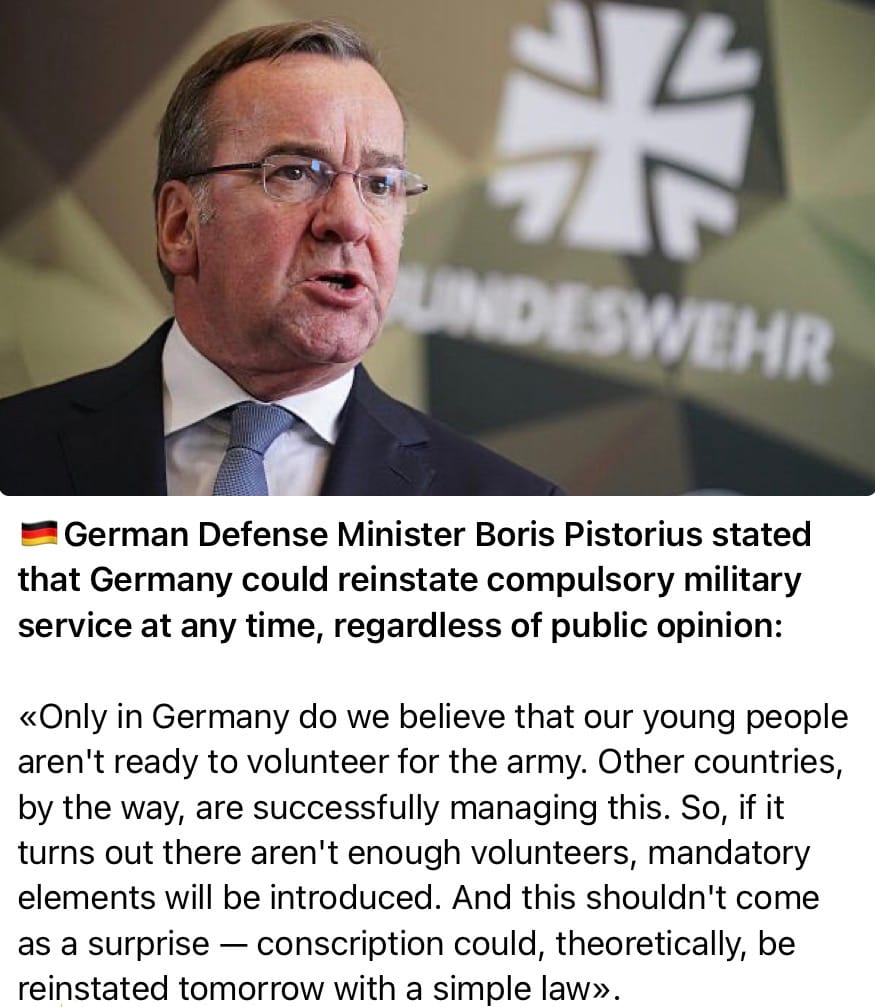
Effective January 1, 2026, all 18-year-old men in Germany must register for potential military service, marking the first such requirement since the end of the Cold War. This initiative aims to expand the Bundeswehr from roughly 182,000 active personnel to over 200,000, including reserves, amid warnings of an imminent Russian threat. On November 6, Inspector General Carsten Breuer declared the current geopolitical landscape the most perilous of his 40-year career, driven by Russia's military posture. A draft bill advanced on November 23 seeks to forge Europe's most formidable army through incentives for volunteers, with compulsory service as a fallback to counter the Ukraine crisis. On November 2, Interior Minister Alexander Dobrindt proposed integrating war and disaster preparedness into school curricula, equipping youth with skills for potential crises. This move underscores a societal pivot: from academic pursuits to survival training, with Ukraine serving as the stark prelude to broader continental risks.
UK WAR CHEST
The United Kingdom's 2025 Spending Review commits £62.2 billion to defense in 2025/26, rising to £73.5 billion by 2029/30—the steepest ascent since the Cold War—coupled with public directives to stockpile 72-hour supplies. Senior officers warn of irreversible escalation absent immediate action, positioning London as NATO's fiscal anchor in the Ukraine endgame.
CANADIAN ARMY URGENCY
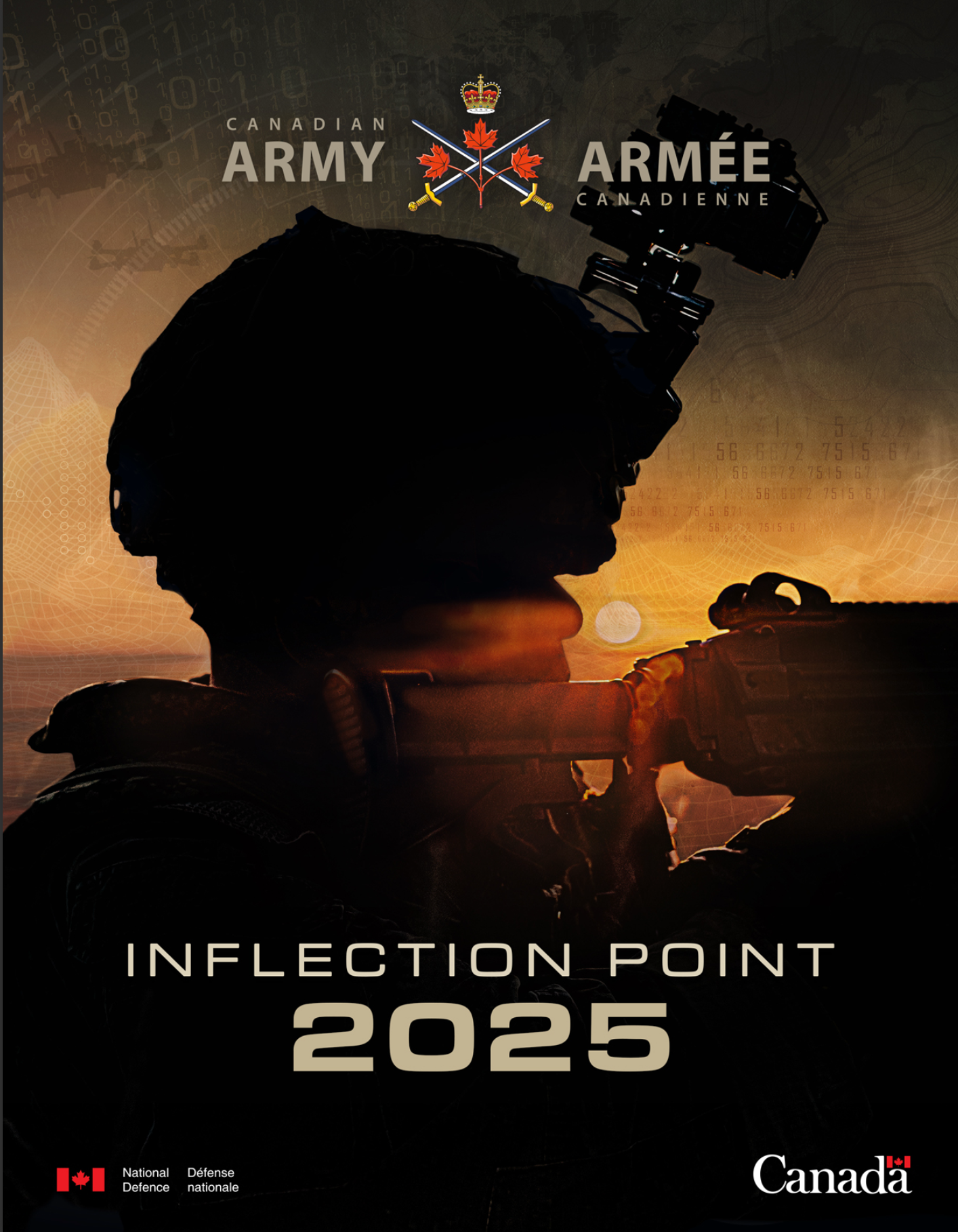
Canada's August 2025 "Inflection Point" strategy exposes a brutal reality: the Canadian Army concedes it is ill-equipped for Major Combat Operations (MCO), optimized for low-threat "contribution warfare" but deficient in crises and devoid of essentials like ground-based air defense, self-propelled artillery, long-range sensors, and division-level sustainment for 15,000 troops. Decades of underinvestment have yielded understaffed infantry, obsolete towed artillery, a lone squadron of aging tanks, and atrophied reserves operating on disjointed systems—hindering integration and readiness quantification. Amid Russia's Ukraine invasion and resurgent state-on-state threats, Chief of the Defence Staff General Jennie Carignan demands urgent scaling to deter peer adversaries, with Arctic sovereignty as a flashpoint priority—yet the core pivot is toward MCO proficiency by 2030, overhauling logistics via automated chains and predictive modeling to project persistent forces anywhere, anytime. Backed by the Mark Carney government's $81.8 billion five-year defense surge—including a $9 billion NATO commitment and a Defence Investment Agency for expedited procurement—this "ambitious" timeline targets reserve growth from 28,000 to 400,000 in 5–10 years, the largest since World War II.
FRANCE DEATH PREP
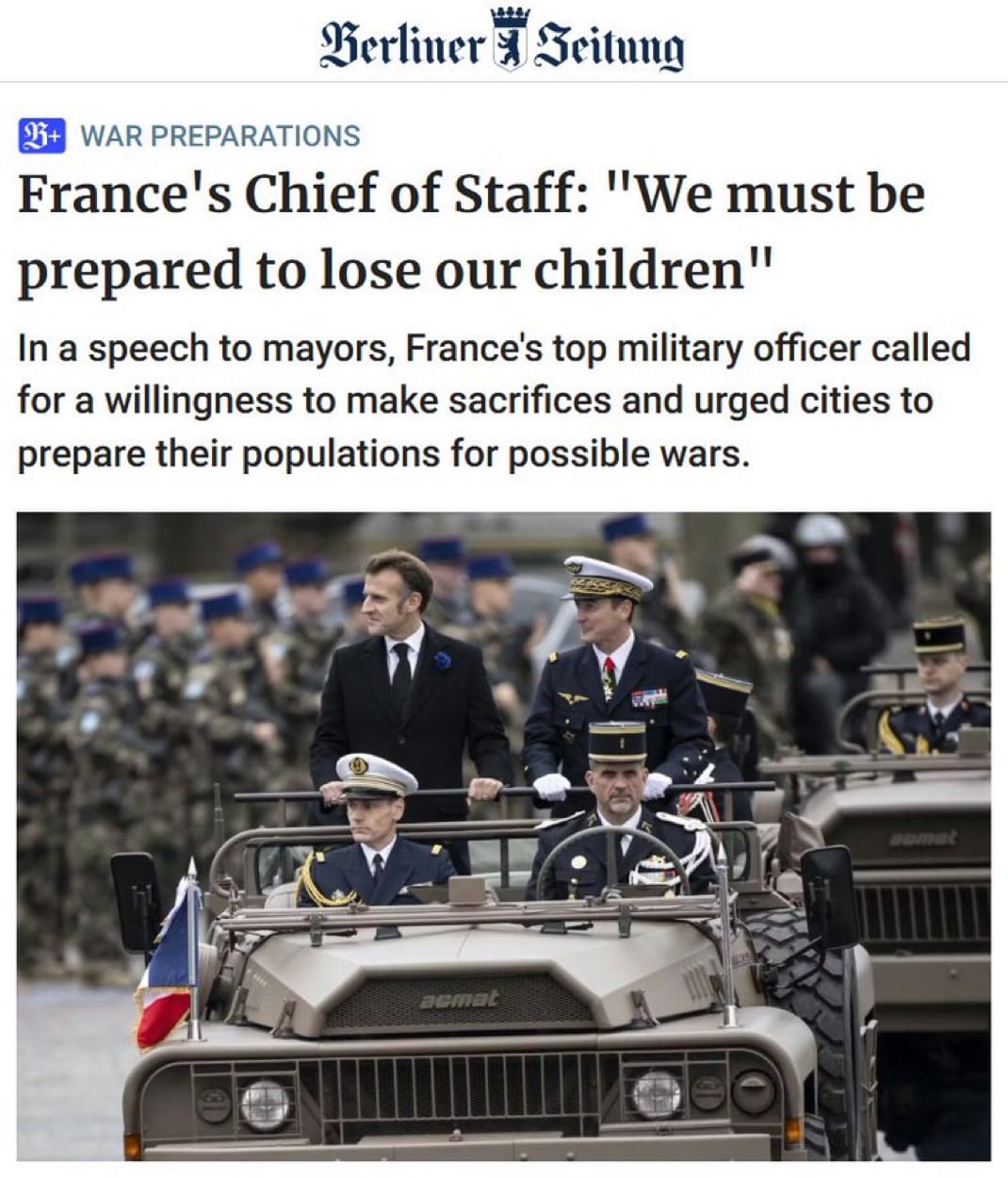
Army Chief of Staff General Fabien Mandon issued a stark admonition in November: France must psychologically brace for the loss of young lives in a conceivable clash with Russia by 2030. His words have ignited national debate, framing Ukraine's attrition as a harbinger that demands unflinching resolve—and revealing the human toll elites quietly anticipate.
EU DOOM KITS
The European Union, building on its March 2025 Preparedness Strategy, urges citizens to assemble 72-hour emergency stockpiles of food, water, and essentials. France and Czechia have disseminated official guides to households, with the latter's recent distribution emphasizing readiness for disruptions like those tested in Ukraine. This is no mere precaution; it is a tacit acknowledgment of war's spillover.
SWEDEN DRAFT
Sweden enforces mandatory national service for all 18-year-olds irrespective of gender, a policy now amplified by proposals to extend conscription liability for officers to age 70. Hosting a NATO civil defense conference November 3–5 amid reports of Russian GPS interference in the Baltic Sea, Stockholm is fortifying its role as a frontline bulwark, primed for Ukraine contingencies.
POLAND RED ALERT
Poland targets 300,000 active troops and 500,000 reservists by 2030, a buildup accelerated by recent sabotage on rail infrastructure near Warsaw and Lublin—incidents Warsaw attributes to Russian orchestration. In response, authorities have declared a pre-war alert and mobilized up to 10,000 soldiers for infrastructure protection, conducting joint exercises with Sweden that simulate escalation from the Ukrainian theater.
DUTCH CASH BLAST
The Netherlands has channeled funds into NATO's Persistent Ukraine Reconnaissance and Logistics initiative, contributing to packages exceeding $2 billion in U.S. equipment deliveries to Kyiv. Bolstering quick-reaction forces against hybrid threats, including cyberattacks traced to Moscow, this support ensures a steady flow of munitions to prolong—and potentially expand—the conflict.
BALTIC BOOT CAMPS
Estonia, Latvia, and Lithuania have instituted compulsory military education for adolescents, while Finland proposes raising reservist age limits to 65, adding 125,000 personnel. Surpassing NATO's 2% spending threshold and aiming for 3.5%, these nations—abutting Russia—view Ukraine's ordeal as their own imminent trial by fire.
EU SHADOW PACT
An eight-nation EU coalition—Belgium, Estonia, Finland, Latvia, Lithuania, Luxembourg, the Netherlands, and Sweden—launched in May coordinates shared stockpiles and response protocols for crises. Ostensibly for resilience, this alliance foreshadows synchronized mobilization should Ukraine's front collapse, binding members in collective peril.
These are not abstract alerts but concrete machinations of escalation. As Brussels and Ottawa orchestrate this continental rearmament, the Ukraine quagmire risks engulfing a generation. The question is not if, but when—and at what price.
 MIND
MIND